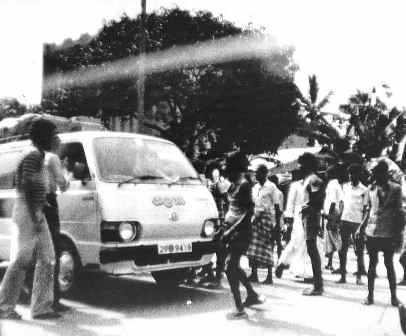
Motorists
were dragged from their cars to be stoned and beaten with sticks during
racial violence in Colombo, the Sri Lanka capital yesterday (24 July).
Others were cut down with knifes and axes. Mobs of Sinhala youth
rampaged through the streets, ransacking homes, shops and offices,
looting them and setting them ablaze, as they sought out members of the
Tamil ethnic minority... A Sri Lankan friend
told me by telephone last night how he had watched horrified earlier in
the day as a mob attacked a Tamil cyclist riding near Colombo's eye
hospital, a few hundred yards from the home of Junius Jayawardene, the
nations 76 year old President. The cyclist was hauled from his bike,
drenched with petrol and set alight. As he ran screaming down the
street, the mob set on him again and hacked him down with jungle
knifes.." (London Daily Telegraph, 26 July 1983)
இதில் அணைத்து சாதி,மதத்தை சேர்ந்தவர்களும்,அணைத்து கட்சியை சேர்ந்தவர்களும், தமிழர் அமைப்பு மற்றும் பிற எல்லா அமைப்பை சேர்ந்தவர்களும் இணைப்போம்,இணைந்துகொள்வோம்.....இது ஒரு அரசியல் கட்சி அல்ல....இது தமிழர் ஒருங்கிணைப்பு அமைப்பு(Tamilar Coordinating Organization) மட்டுமே..... தமிழ் இனத்திற்கு ,தமிழ் இனத்தின் விடுதலைக்கு முன்னுரிமை கொடுக்கும் அமைப்பு,அதற்கு தமிழ் மக்களை...ஒன்றுதிரட்டும் பணியை செய்வது.
Tuesday, 23 July 2013
Sinhala mob dancing around a Tamil youth, stripped naked, before pouring petrol and burning him to death
Sinhala mob dancing around a Tamil youth, stripped naked, before pouring petrol and burning him to death, Colombo, 23 July 1983
A tourist told yesterday how she watched in horror as a Sinhala mob deliberately burned alive a bus load of Tamils

''Pillars
of smoke and flame rose over the Sri Lankan capital, Colombo yesterday
as mobs attacked the minority Tamil community and looted their homes and
stores...Some of the worst rioting erupted in the morning only 200
yards away from President Jayawardene's house... All over the city by
mid-morning lorries jammed with young men shouting anti Tamil slogans,
were moving into Tamil areas and into shopping
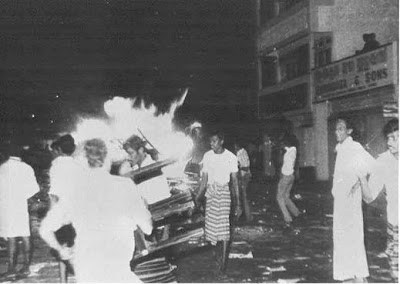
centres picking out Tamil shops... Petrol was siphoned from cars into
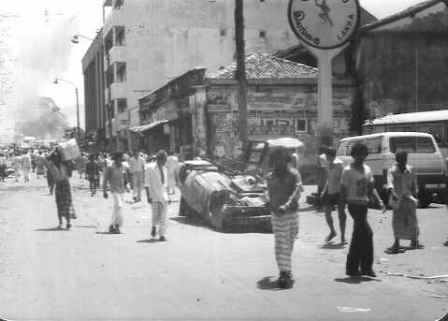
buckets and plastic bowls to speed the work of arson.. By noon Colombo
resembled a city after a bombing raid. Smoke obscured the sun, main
roads were blocked by burnt out vehicles.. The rioting surged into the
heart of the city. In area after area Sinhalese rioters systematically
picked out Tamil homes and shops, whether occupied or empty, and looted
and destroyed them...'' (Guardian, 26 July 1983)
''A tourist told yesterday how she watched in horror as a Sinhala mob deliberately burned alive a bus load of Tamils... Mrs.Eli Skarstein, back home in Stavanger, Norway, told how she and her 15 year old daughter, Kristin, witnessed one massacre. 'A mini bus full of Tamils were forced to stop in front of us in Colombo' she said. A Sinhalese mob poured petrol over the bus and set it on fire. They blocked the car door and prevented the Tamils from leaving the vehicle. 'Hundreds of spectators watched as about 20 Tamils were burned to death'. Mrs. Skarstein added: 'We can't believe the official casualty figures. Hundreds may be thousands must have been killed already." (London Daily Express, 29th August 1983)
Eye witnesses and victims reported that on the streets cars were stopped by gangs and the people inside were asked whether they were Sinhalese or Tamil

''Eye
witnesses and victims reported that on the streets cars were stopped by
gangs and the people inside were asked whether they were Sinhalese or
Tamil. Some Sinhalese words are extremely difficult for people who do
not speak the language fluently to pronounce, people were tested by
being made to pronounce these words. The mobs were also demanding to see
identity cards to establish whether or not
people were Tamils... People identified as Tamils as a result of the
questioning were told to get out of their cars and their cars were set
alight... In cases where any resistance was offered, killings were
likely to take place... It was reported by many people that in some
instances students from Buddhist schools followed on behind the first
rioters and that some Buddhist monks were seen amongst the gangs''
(Patricia Hyndman, Senior Lecturer in Law, University of New South Wales
and Secretary, Lawasia Human Rights Standing Committee Report
-Democracy in Peril, June 1985)
About 100 industrial plants were severly damaged or destroyed, including 20 garment factories
'About
100 industrial plants were severly damaged or destroyed, including 20
garment factories. The cost of industrial reconstruction was estimated
at 2,000 million rupees (£55 million). This did not include damaged
shops.'' (The Guardian, 9 August 1983)
The New York Times reported in early August: ''The shells of (Tamil owned) businesses line Galle Road, the main waterfront thoroughfare advertising the names that marked them for destruction. Lakshmi Mahal, pawbroker, or Ram Gram stores and florist.. Damage estimates are uncertain and incomplete, but the total economic loss has been placed at $300 million.''
''Seventeen industrial complexes belonging to some of the leading Tamil... industrialists were razed to the ground... Several cinemas owned by Tamils were destroyed... Probably the worst affected area was the Pettah, the commercial centre of Colombo, where Tamil and Indian traders played a dominant role. Hardly a single Tamil or Indian establishment was left standing.'' (Eye witness account, Sri Lanka: Racism and the Authoritarian State - Race and Class, Volume XXVI, A.Sivanandan and Hazel Waters, Institute of Race Relations)
The New York Times reported in early August: ''The shells of (Tamil owned) businesses line Galle Road, the main waterfront thoroughfare advertising the names that marked them for destruction. Lakshmi Mahal, pawbroker, or Ram Gram stores and florist.. Damage estimates are uncertain and incomplete, but the total economic loss has been placed at $300 million.''
''Seventeen industrial complexes belonging to some of the leading Tamil... industrialists were razed to the ground... Several cinemas owned by Tamils were destroyed... Probably the worst affected area was the Pettah, the commercial centre of Colombo, where Tamil and Indian traders played a dominant role. Hardly a single Tamil or Indian establishment was left standing.'' (Eye witness account, Sri Lanka: Racism and the Authoritarian State - Race and Class, Volume XXVI, A.Sivanandan and Hazel Waters, Institute of Race Relations)
Estimates of the number of persons killed in the week of violence vary
''Estimates
of the number of persons killed in the week of violence vary. Official
estimates are just under 400 killed. These estimates are conservative.
Unofficial estimates are as high as 1500 to 2000. It is probable that
many bodies were not at first discovered because they were burned in
houses. Also some bodies were hidden and buried privately by people who
were frightened by the prospect of further
reprisals should the bodies be discovered, or scared to attract
attention to themselves by reporting the deaths. At the date of our
departure from Sri Lanka, September 1st, there were many people still
missing or not accounted for.'' (Patricia Hyndman, Senior Lecturer in
Law, University of New South Wales and Secretary, Lawasia Human Rights
Standing Committee Report -Democracy in Peril, June 1985)

Smoke
from hundreds of shops, offices, warehouses and homes blew idly over
Colombo yesterday. Any business, any house belonging to or occupied by a
Tamil has been attacked by gangs of goondas and the resulting
destruction looks like London after a heavy night's attention from the
Luftwaffe. The sharp smell of destruction fills the nostrils and the
roads beneath the feet crunch with broken glass. Cars
and lorries lie at ungainly angles across the footways. In Pettah, the
old commercial heart of the city, row after row of sari boutiques,
electronic dealers, rice sellers, car parts stores, lie shattered and
scarred... government officials yesterday estimated that 20,000
businesses had been attacked in the city." (The Guardian, 28 July 1983)
The police and the government made no attempt to stop or hinder small gangs of men who went about with lists
"Tamil
owned businesses account for between 50 and 60 percent of the
commercial life of the capital and they have been destroyed -
scientifically extracted from among their neighbours and burned." (The
London Times, 2 August 1983)

''The
police and the government made no attempt to stop or hinder small gangs
of men who went about with lists, burning the houses and flats (in
Sinhala owned dwellings only the contents), grocery stores, pharmacies,
textile shops, tailoring establishments, restaurants, bookshops,
hardware shops, lawyers offices, studios... as well as tourist hotels.
They also burnt trucks, vans and cars. They went
for only those things which were owned by (Tamils)... They did this
expertly.... within sight of President's House in the administrative and
business centre, a few yards away from the Prime Minister's official
residence, near the UNP headquarters, in blocks immediately adjacent to
or opposite major police stations - taking care, on a hot, dry morning,
not to start fires which would spread to adjacent Sinhalese owned or
state property. Accidents and violations of 'discipline' were few.''
(Sri Lanka - The Unfinished Quest for Peace - L.Piyadasa, Marram Books,
1988)
Subscribe to:
Posts (Atom)